Artificial intelligence is quickly becoming part of the conversation across architecture, engineering and construction. AI assistants can answer questions, analyse documents, identify patterns, automate tasks and increasingly interact with the software that project teams already use.
But there is a more fundamental question that organisations should ask before deciding which AI tool to deploy:
Is our project information actually ready for AI to use?
AI does not turn poorly structured project information into reliable intelligence simply because an AI layer has been added. If information is incomplete, inconsistent, inaccessible or spread across disconnected systems, AI inherits those problems.
For the built environment, the path to useful AI therefore starts much earlier.
It starts with the way we structure information.
BIM was already a major step towards machine-readable construction information
The industry has spent decades moving from drawings towards increasingly information-rich digital models.
CAD digitised drawings.
BIM added objects, relationships and information to those drawings.
Open standards such as IFC made it possible to exchange model information between different systems.
Common data environments brought models, documents and project processes into more connected digital workflows.
Now AI creates the possibility of doing much more with all that information.
But there is an important distinction between having BIM data and having data that is ready to support automation and AI.
A project may contain sophisticated BIM models while still having inconsistent parameter names, missing classifications, information stored in the wrong fields, different naming conventions between disciplines, important requirements buried in PDFs, duplicated or outdated information, project knowledge residing primarily with individual team members, and models that humans can understand visually but software cannot reliably interpret.
For a modeller looking at the model, some of these inconsistencies may be manageable. For software trying to analyse thousands of objects automatically, they become significant.
The next transition is from models to accessible data
One of the important changes now taking place in AEC technology is that information is increasingly being separated from the files in which it was originally created.
Autodesk, for example, describes its AEC Data Model as a way of making granular design and project data more accessible, connected and usable instead of leaving information trapped inside large files. Autodesk specifically identifies automation, analytics and artificial intelligence as potential uses of this more accessible data.
This represents a broader industry shift.
The question is no longer only:
“Do we have a BIM model?”
Increasingly, it becomes:
“Can the information inside our models be found, understood, queried, validated and used by other systems?”
That is a much higher standard.
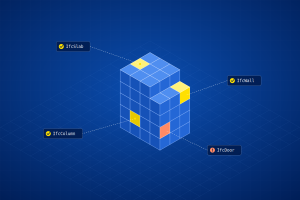
An AI system cannot reliably reason about a fire-rated door, for example, if the system cannot consistently identify which objects are doors, which property represents the fire rating, what units or allowable values are used, or which requirement applies.
The geometry may already exist.
The information may even exist somewhere.
But unless that information is structured and understandable to machines, its usefulness for automation and AI remains limited.
CORENET X shows why information structure matters
Singapore’s transition towards CORENET X provides a useful example of this change.
CORENET X introduces BIM submission in the IFC+SG format and is designed around more coordinated digital regulatory workflows. Its Automated Model Checker is intended to support automated checking of straightforward regulatory requirements and allow consultants to carry out self-checking before submission.
For this to work, a model cannot merely look correct.
The relevant building elements need to be represented correctly, and the required information needs to be embedded in a form that software can recognise and assess. The CORENET X Code of Practice, for example, explicitly refers to IFC+SG data requirements being embedded in BIM components.
This illustrates an important principle that goes well beyond regulatory submission:
Machines need explicit information where humans have traditionally relied on interpretation.
A human reviewing a model may recognise that an object is a wash basin because of its shape and location.
A checking system needs that object to be classified appropriately and supplied with the information needed for the particular rule being evaluated.
AI may eventually become much better at resolving ambiguity, but the reliability of the workflow still improves dramatically when the underlying information is properly structured.
Structured information creates the foundation for automation
At AcePLP, our work on automated BIM and regulatory checking has reinforced this repeatedly.
Turning a written requirement into an automated check requires several questions to be answered.
-
What building element does the requirement apply to?
-
What information must exist on that element?
-
Is the information represented as geometry, a property, a classification or a relationship?
-
What constitutes compliance?
-
Can the requirement be evaluated objectively?
-
What should happen when the system finds a problem?
These are information-structure questions before they are software questions.
For example, a requirement involving a measurable minimum width can potentially become a deterministic rule: retrieve the correct element, obtain or calculate the relevant dimension, compare it against the prescribed requirement, and report the result.
But that process breaks down if the software cannot reliably identify the object or obtain the required information.
This is why data quality and modelling discipline are not administrative concerns sitting beside automation. They are prerequisites for automation.
AI should not replace deterministic checking where deterministic checking is better
The rise of AI does not mean every process should suddenly become probabilistic.
Some built environment tasks are better handled by explicit rules.
If a regulatory requirement states that a particular dimension must meet a specified threshold, an auditable rule can determine whether that condition has been satisfied. The result should not depend on how an AI model happens to interpret the requirement on a particular day.
AI can instead add value around that deterministic process. It can help a user understand why an issue was raised, retrieve the relevant modelling guidance, explain the regulatory context, diagnose why information is missing, and recommend the next action. It can make a complex checking system much easier for a human to interact with.
The strongest construction AI workflows are unlikely to consist of AI replacing every existing process.
They will combine structured information, deterministic automation, domain rules and AI, using each where it is strongest.
Project data alone is not enough: AI also needs organisational knowledge
There is another layer to the problem.
Much of what makes an experienced BIM manager, coordinator or modeller effective does not sit neatly inside a BIM model.
It may exist in BIM standards, modelling guides, project information requirements, regulatory guidance, previous project lessons, software limitations, checking procedures, internal QA practices, client-specific requirements, technical decisions and precedents. Sometimes it exists only in the experience of senior employees.
This becomes particularly important when organisations introduce generative AI.
Giving an AI assistant access to thousands of documents does not automatically create an authoritative organisational knowledge system. The system still needs to understand which information is current, which requirements apply in which situation, which sources have been approved and how different pieces of knowledge relate to one another.
This is why we have also been exploring ways of structuring enterprise BIM knowledge so that AI can retrieve not simply information, but the right information in the right context.
The objective is not to replace technical judgement.
It is to make trusted organisational knowledge easier to find and apply, particularly where teams would otherwise repeatedly search for information or depend on a small number of experienced individuals to answer the same questions.
What does “AI-ready” construction information actually look like?
An organisation does not need perfect data before it can start experimenting with AI.
But several characteristics make information substantially more useful.
Consistent
The same concepts should be represented in reasonably consistent ways across models, projects and systems.
If one project uses the parameter “FireRating”, another uses “FR”, and a third records the same information in an unrelated parameter, automated use becomes harder.
Structured
Important information should not exist only as unstructured text where a structured property, classification or relationship would be more appropriate.
Complete enough for the intended use
AI readiness does not mean collecting every conceivable piece of data.
It means ensuring that the information needed for the intended workflow actually exists.
A system designed to support model checking requires different information from one designed to analyse project correspondence.
Contextual
Software needs to understand what information refers to, how objects relate to one another and which requirements or project conditions apply.
Accessible
Information that is technically structured but locked inside disconnected files or systems may still be difficult to use.
APIs, common data environments, open standards and connected data platforms increasingly matter because they allow information to be accessed by workflows beyond the software in which it originated.
Governed
Teams need to know who owns information, which sources are authoritative, how changes are approved and which version should be relied upon.
Traceable
Particularly for compliance and technical decision-making, users need to be able to understand where an answer or recommendation came from.
These qualities benefit far more than AI.
They also improve coordination, checking, reporting, analytics, handover and ordinary project delivery.
That is why investment in information structure is rarely an “AI-only” investment.
The mistake is starting with the AI tool
Organisations often begin AI discussions by asking:
Which AI product should we buy?
A better starting point is:
Which workflow are we trying to improve, and what information would a system need to improve it?
Consider a company that wants AI to help identify model-quality problems.
Before selecting an AI tool, the team should understand:
-
What problems are currently being found manually?
-
Which of these can already be expressed as deterministic rules?
-
What information is required to evaluate them?
-
Is that information consistently available?
-
Where is the information stored?
-
Which decisions genuinely require AI rather than conventional automation?
-
How will results be reviewed and approved?
The technology decision comes after these questions, not before them.
Connected platforms are making this increasingly possible
The technology market is moving in the same direction.
Autodesk now positions Forma as an AI-native, cloud-based platform connecting people, data and workflows across the built environment. Its current direction brings together data management, design and construction workflows, while Autodesk’s AEC Data Model makes granular project information available for APIs, analytics and automation.
That creates significant opportunities.
But connecting data does not remove the need to govern it.
If organisations want AI systems to interrogate models, coordinate information, automate workflows or support decisions, someone still needs to define what the information means, how it should be structured and how the resulting workflow should operate.
That is where built-environment domain knowledge becomes particularly important.
A practical path from BIM to AI
For most organisations, becoming AI-ready should not begin as a massive transformation programme.
Start with a specific workflow where there is a clear operational problem.
Then:
Identify the information required.
Determine what the system would need to know to perform the task.
Assess the current information.
Find the missing, inconsistent, duplicated or inaccessible information.
Standardise and govern it.
Establish appropriate classifications, parameters, naming conventions, ownership and information requirements.
Connect the information.
Determine how models, documents, project systems and enterprise knowledge need to interact.
Automate what can be deterministic.
Use explicit rules where they provide a more reliable and auditable solution.
Introduce AI where it adds something different.
Use AI for areas such as natural-language interaction, interpretation, knowledge retrieval, pattern recognition or workflow orchestration where those capabilities create genuine value.
Measure the outcome.
The success measure should not be that an organisation has “implemented AI”. It should be that a real project workflow has become faster, more reliable, easier to execute or less dependent on repetitive manual work.
From digital delivery to AI-ready delivery
The progression from BIM to AI is therefore not a sudden technological leap.
It is a continuation of the industry’s long transition towards better digital information.
-
Drawings made information digital.
-
BIM made building information structured around objects.
-
Open standards made that information more interoperable.
-
Information management made it more governed.
-
Connected data platforms are making it more accessible.
-
Automation makes structured information actionable.
-
AI can make that connected information and knowledge increasingly usable through natural language, reasoning and intelligent workflows.
Each step depends on the foundations underneath it.
The organisations that gain the most from construction AI are therefore unlikely to be those that simply adopt the largest number of AI tools.
They will be the organisations that understand their information well enough to make those tools useful.
At AcePLP, we see AI implementation as the next stage of digital delivery: combining built-environment expertise with BIM, openBIM, information governance, workflow automation and connected technology to prepare project information for new ways of working.
Before asking what AI can do with your projects, start by asking whether your project information is ready for AI.
Frequently Asked Questions
What does it mean for BIM data to be AI-ready?
AI-ready BIM information is information that machines can reliably find, interpret and use for a defined workflow.
It should be sufficiently consistent, structured, complete and contextual for its intended purpose. It should also be accessible to the systems that need it, governed so users know which information is authoritative, and traceable where decisions or technical recommendations need to be verified.
AI readiness does not mean collecting every possible piece of information. It means having the right information, represented consistently enough for the intended use.
Why does structured BIM data matter for AI in construction?
AI cannot reliably act on building information if it cannot determine what an object is, where the relevant information is stored or which requirement applies.
Structured BIM data gives software explicit information about objects, properties, classifications and relationships. This makes project information easier to query, validate, automate and use within AI-enabled workflows.
The better the underlying information structure, the less the system needs to rely on ambiguity or inference.
Can AI work with unstructured or inconsistent construction information?
AI can work with unstructured information such as documents and natural language, but that does not remove the problems caused by inconsistent or incomplete project information.
For technical workflows such as model checking, information retrieval or compliance assessment, reliability improves when important information is represented consistently and the system can identify authoritative sources.
Adding AI therefore does not automatically make poor information reliable.
Can AI replace rule-based BIM and regulatory checking?
Not necessarily, and in many cases it should not.
Where a requirement can be expressed objectively, for example, checking whether a specified dimension meets a defined threshold, a deterministic rule can provide a repeatable and auditable result.
AI can add value around that process by helping users understand why an issue was raised, retrieving relevant guidance, explaining context, diagnosing missing information or recommending the next action.
Effective construction AI is therefore likely to combine structured information, deterministic automation, domain rules and AI rather than replacing every existing process with AI.
Do organisations need perfect BIM data before they can start using AI?
No. Organisations do not need to achieve perfect information before experimenting with AI.
A better approach is to start with a specific workflow or operational problem and identify what information is actually needed to improve it. Teams can then assess gaps, standardise the relevant information and introduce automation or AI where it creates measurable value.
This keeps AI implementation tied to a real business or project outcome rather than turning data improvement into an endless exercise.
How can a construction company prepare its BIM information for AI?
Start with the workflow rather than the AI product.
Identify the task that needs improvement and determine what information a system would need to perform it. Then assess the current information for gaps or inconsistencies, standardise and govern the required data, connect the relevant models, documents and systems, automate deterministic processes where appropriate, and introduce AI where capabilities such as natural-language interaction, knowledge retrieval or interpretation add genuine value.
The goal should not simply be to say that AI has been implemented. The goal is to make a real project workflow faster, more reliable or easier to execute.